
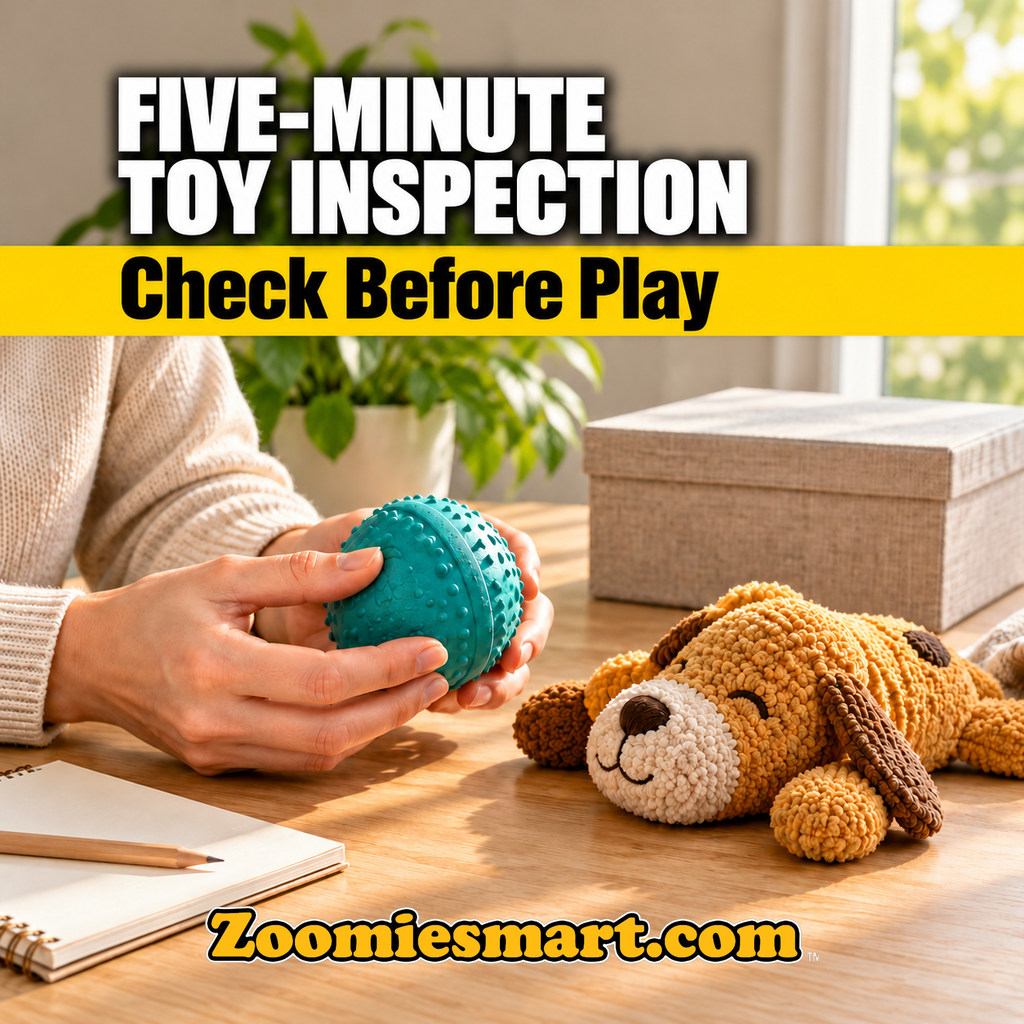
A Five-Minute Toy Inspection Before Play
Before you throw the ball or bring out the cat's favorite kicker, take a few minutes to look at what you are handing over. A toy can look familiar and still have a new tear, a missing piece or a size that no longer suits the pet using it.
This five-minute routine is an organizing tool, not a safety test or a guarantee against choking or injury. Take longer when you need to, and follow the toy manufacturer's instructions. KONG, for example, calls for supervision, regular inspection and removal of damaged toys. KONG toy-use guidance
Minute one: choose the pet and the game
Put the toys for this session on a clear surface while your pet is occupied elsewhere. Decide who will use each one and what you will be doing: fetching, gentle carrying, a food puzzle or an interactive cat game.
Read the intended use and size guidance. A toy selected for a small dog may not suit a larger housemate. A toy that once suited a growing puppy may need reassessment. Do not make “the dog has always had it” your only reason to keep using it.
Seattle Humane emphasizes that suitability depends on a dog's size, activity and play style, and warns that undersized toys can be swallowed or lodge in the throat. Seattle Humane toy guidance
Decision: if you cannot confirm that the toy suits this pet and this game, leave it out of the session.
Minute two: inspect the outside from every side
Turn each toy over in good light. Start at one point and work all the way around rather than looking only at the side you usually see.
- Plush toys: check seams and fabric for openings, visible stuffing or an exposed squeaker.
- Rubber and other molded toys: look for cracks, missing chunks and changed edges.
- Balls: examine the whole surface, not just the spot your hand naturally grips.
KONG identifies cracks, missing pieces, exposed stuffing and accessible squeakers as reasons to replace a toy. A tougher-sounding label does not cancel those warning signs. KONG replacement guidance
Decision: put damaged toys directly into a container your pet cannot access. Do not leave them on the floor while you finish inspecting the rest.
Minute three: check attachments and account for pieces
Look closely at ears, tails, decorative eyes, cords, feathers and other attachments. Compare the toy with its original shape or product photo if you are unsure whether anything is missing. Check a puzzle's intended removable pieces against its instructions before putting them back.
For cats, pay particular attention to small parts and strand-like attachments. Cornell's Feline Health Center recommends avoiding toys with small pieces, feathers or string that can detach and be swallowed. An attachment being popular with your cat does not make it appropriate to leave within reach. Cornell's safe-toy guidance
Decision: if an attachment is coming loose, retire the toy from play. If a part is missing and you think it may have been swallowed, use the veterinary advice below rather than simply choosing another toy.
Minute four: sort into three destinations
Use three labels on a shelf, tray or storage box:
- Ready for this session: the toy fits its intended use, the check found no damage, and it is ready to use under its instructions.
- Clean before use: the toy needs its labeled cleaning routine. Keep it separate from the ready group until that job is finished.
- Remove from play: the toy is damaged, incomplete, unsuitable or awaiting an answer from the manufacturer.
This is a practical sorting system, not a certification. “Ready” means only that you have completed your check; keep watching during play.
Avoid a fourth pile called “probably fine.” If you are undecided, put the toy in the remove-from-play group. Do not improvise a tape or glue repair and assume the toy has returned to its original condition. Ask the manufacturer whether it has an approved repair or replacement part.
Minute five: set up the play space
Put unused toys away and check the area where today's game will happen. For cats, Cornell advises considering falling objects and places a distracted cat could fall from during play. Move the game away from unstable decorations or an unsafe edge. Cornell's play-space guidance
In a mixed-pet household, keep the cat's small toys away from a dog who might pick them up. Check the manufacturer's supervision and storage instructions before starting. Stay ready to end the game if the toy begins to come apart; the pre-play inspection is not the last inspection.
If you think a piece was swallowed
Contact a veterinarian immediately if you suspect your dog or cat swallowed a toy fragment or other foreign object. The University of Illinois Veterinary Teaching Hospital explains that swallowed objects can cause serious obstructions. Vomiting, gagging, reduced appetite, abnormal defecation and abdominal pain can occur, but suspicion of ingestion is enough to seek veterinary care. University of Illinois foreign-body guidance
Keep the remaining toy and packaging to help identify what may be missing. Let the veterinary team direct the next step rather than trying a home remedy or waiting for the object to appear.
Make the next check easier
Keep a note with three fields: toy, issue noticed, action taken. “Blue ball, split seam, removed” is enough. If the same kind of toy repeatedly fails during your pet's usual play, use that record when asking your veterinarian or the manufacturer about a better match.
Finish each session by collecting the toys and noticing what changed. The aim is a repeatable habit: choose thoughtfully, inspect before use, watch during play, and remove damaged items promptly.