
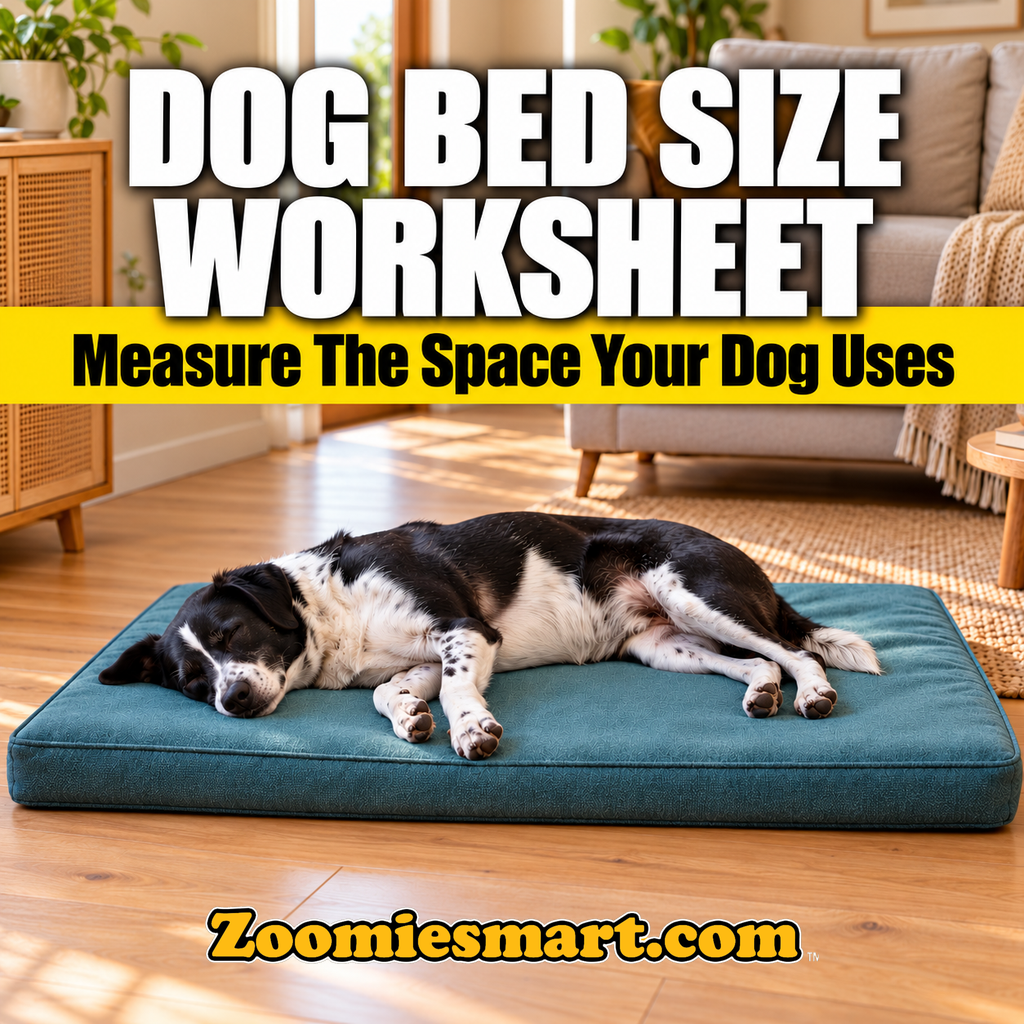
A Dog Bed Size Worksheet: Measure Sleeping Space Before You Buy
A bed can fit neatly beside the sofa and still leave your dog's paws hanging over the edge. The number to compare with your dog's sleeping space is the usable resting area, which may be smaller than the bed's overall dimensions.
This worksheet helps you collect three things before choosing a size: the space your dog actually uses, the space the bed provides, and the space available in your room. You will need a tape measure, a notepad, and a few observations of your dog resting naturally.
1. Observe more than one sleeping position
Watch your dog over several normal naps. A curled-up position is a useful observation, but it should not be the only one. Note how much space they use lying on their side or stretching their legs.
The RSPCA advises choosing a bed that accommodates a dog's natural sleeping positions, including stretching out. It also notes that individual dogs have different preferences for bed styles. A snug-looking photograph is not enough to establish fit. Read the RSPCA's dog-bed guidance.
Do not move your dog's legs or wake them to obtain a measurement. Instead, note the area they occupy and measure the surface once they move away. A nearby floor seam or the edges of their current mat can help you record where their body and paws were.
Write down the longest occupied distance and the widest occupied distance. Include the head and outstretched paws, not just the torso. These observations describe a sleeping footprint; they are not a manufacturer-issued size chart.
2. Separate overall size from usable space
When comparing listings, label each dimension before using it:
- Overall length and width: the space the entire bed takes up, including raised sides.
- Usable resting length and width: the space inside those sides where your dog can lie.
- Overall diameter: the full width across a round bed, potentially including its rim.
- Inner diameter: the space inside that rim. A circular space also narrows away from its center, so do not treat it as a square of the same width.
- Entry height: the edge your dog must step over to get in and out.
For a flat mat, overall size may be close to resting size. For a bolster bed, the difference can be substantial. Ask for the actual interior measurements rather than estimating them from a photograph. A soft rim's thickness can vary, so subtracting a guessed border width is unreliable.
A size label such as “large” or “XL” does not tell you which of these dimensions the seller means. Weight guidance can help shortlist products, but it cannot describe the shape your dog makes when asleep.
3. Fill in your dog's worksheet
Use inches or centimeters consistently. Repeat this block for each dog.
- Dog's name: ____________________
- Measurement date: ____________________
- Units used: ____________________
- Curled resting footprint, length × width: ____________________
- Side-lying or stretched footprint, length × width: ____________________
- Other common position and footprint: ____________________
- Longest and widest observed distances: ____________________
- Current bed: what fits well, and where does space run out? ____________________
- Entry needs or difficulty stepping over an edge: ____________________
Then complete one comparison block per candidate bed:
- Product and exact size/variant: ____________________
- Overall dimensions: ____________________
- Confirmed usable resting dimensions: ____________________
- Shape and raised-side layout: ____________________
- Entry height: ____________________
- Source of measurements and date checked: ____________________
- Enough room for observed positions and changing position? Yes / No / Unclear
- Fits the intended room location without blocking access? Yes / No
- Unanswered question for the seller: ____________________
Leave “unclear” as unclear. It is a reason to ask a question, not a reason to assume the larger-looking option will work.
4. Compare dimensions without inventing an allowance
There is no single extra-inch rule in this worksheet. Start with your observations, follow the particular manufacturer's sizing instructions, and look for room to change position rather than an exact edge-to-edge match.
For example, imagine a dog's stretched footprint is 30 × 18 inches. A listing gives an overall size of 36 × 24 inches, but the confirmed inner resting area is 28 × 16 inches. That inner area is smaller than the observed footprint in both directions. The headline dimensions would have hidden the mismatch. These are illustrative numbers, not measurements for a ZoomiesMart product.
You can lay a towel flat to visualize a candidate's usable area before ordering. Measure the towel's outline and observe your dog nearby during normal rest. Do not restrict your dog to the outline; this is a visual comparison, not a test they need to pass.
5. Ask the right question about a real listing
The Plush Calming Pet Bed lists size options of 40 cm/15.7 in and 50 cm/19.7 in. Its size-guide illustration labels these as diameter measurements across the bed, but does not provide a separate inner resting diameter. Before choosing, confirm the usable resting area for the exact option. Do not assume the listed number is the clear space inside the rim.
A useful question is: “For this size, what are the usable sleeping dimensions inside the raised edge, and what is the entry height?” If the answer is unavailable, keep comparing rather than choosing by product name. “Calming” in a product name does not establish a treatment for anxiety.
6. Check the bed after it arrives
Set up the bed according to its instructions and give your dog a choice about using it. Watch whether they can enter, turn, settle, and use their usual resting positions without having to squeeze against the sides. Recheck the usable space with any liner or blanket you intend to add.
For a dog with mobility difficulties, discuss individual bedding needs with your veterinarian rather than choosing from a comfort claim alone. Keep the care label and follow its washing instructions.
Before you order: confirm the exact variant, the usable resting area, the overall footprint, and the entry height. Those four details are more useful than a breed photo or a size name.